
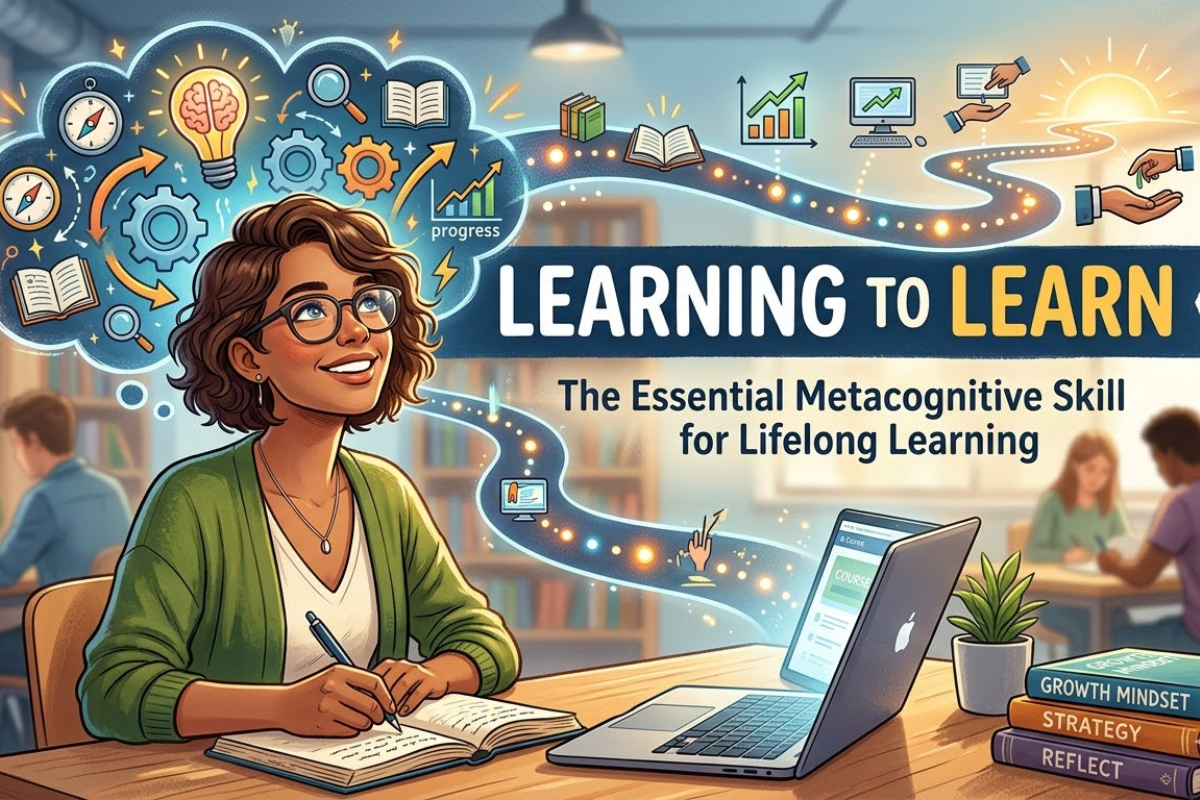
Learning to Learn, the Essential Metacognitive Skill for Life Long Learning
At the outset, heartfelt gratitude to the Senior Management of AGS and all AUS heads for organizing an enlightening session of educators on ‘Learning to Learn’. Many thought-provoking discussions happened and insights were shared by representatives of different subject verticals.
The question that needs to be addressed now is, ‘What Next?’
This note intends to explore the above question and extrapolate by addressing the Why? Who? And How?
Why?
Learning to Learn: The Keystone of Lifelong Success
In the 21st century, knowledge is no longer a static commodity. It evolves continuously and often unpredictably. Knowledge is the basis of every smart decision, every big idea, every successful strategy—but not all knowledge works the same way. We, humans follow varied paths to acquire and employ knowledge, some are elaborated below
1. Declarative Knowledge (Facts, data, information)
2. Explicit knowledge (documentation)
3. Implicit Knowledge (undocumented but understood and followed)
4. Procedural Knowledge (step by step guidelines to perform a task)
5. Empirical Knowledge (experience or experimentation)
6. Priori Knowledge (exists independently – truths)
7. Institutional Knowledge (about an institution’s vision, evolution, culture)
8. Expert Knowledge (specialization in a field)
9. Conceptual Knowledge (concepts, principles and relationships between ideas)
10. Metacognitive Knowledge (awareness of one’s own learning processes and strategies)
Subsequently one needs a variety of skillsets (LOTS, MOTS, HOTS) to acquire and employ different types of knowledge e.g. Declarative Knowledge works well with skill of remembering, procedural knowledge with skill of applying and conceptual knowledge needs the skills of analysing, associating, categorizing and so on.
In such a landscape, one skill rises above all others in importance: “Learning to Learn”. This metacognitive ability refers to an individual’s capacity to plan, monitor, and evaluate their own learning process. It encompasses skills like critical thinking, reflection, adaptability, agility, dynamism, and intrinsic motivation.
As the world transitions from an industrial to a knowledge-based economy, it is no longer sufficient to learn facts or procedures; individuals must know how to learn in order to adapt, grow, and thrive throughout life. This is an attempt to explore the meaning and scope of “Learning to Learn”, its lifelong significance, and how educators can cultivate this skill in their students.
Understanding “Learning to Learn”
Deeper understanding of the concept will equip us to utilise it effectively and imbue the skills essential for learning to learn in our learners
Definition and Core Components
“Learning to Learn” refers to the ability to manage one’s own learning by becoming aware of how one learns best, identifying goals, selecting strategies, and evaluating outcomes.
Key components include:
Ø Metacognition: Thinking about one’s thinking and learning processes.
Ø Self-regulation: Planning, monitoring, and adjusting approaches to learning.
Ø Motivation and Mindset: Having a growth mindset and being intrinsically motivated.
Ø Strategic learning: Choosing and using appropriate strategies for different learning tasks.
Theoretical Foundations
These components are derived from the following education theories
Ø Constructivist Theory (Piaget, Vygotsky): Emphasizes active learning, where learners construct knowledge through experience and reflection.
Ø Bloom’s Taxonomy: The higher-order cognitive domains (analysing, evaluating, creating) align closely with “learning to learn” capacities.
Ø Kolb’s Experiential Learning Cycle: Reinforces reflective observation and abstract conceptualization as tools for metacognitive growth.
Significance of “Learning to Learn” in a Changing World
Ø In an age of automation and AI, routine skills become obsolete quickly.
Ø Careers today are nonlinear, requiring individuals to reskill and upskill continuously.
Ø “Learning to Learn” is crucial for adaptability in dynamic education space and job market.
Ø People with learning autonomy are better decision-makers, innovators, and problem-solvers.
Ø It enables lifelong learning — a key indicator of success and satisfaction in adulthood.
Ø It supports well-being by promoting confidence and resilience in unfamiliar and at times adverse situations.
Ø An informed citizen requires the ability to critically analyse information and distinguish truth from misinformation.
Ø Learning to learn fosters reflective thinking, essential for democratic participation and social responsibility.
Alignment with NEP 2020
ü The National Education Policy 2020 emphasizes experiential learning, critical thinking, problem solving, metacognition, and self-directed learning.
ü The policy envisions “learning how to learn” as a core competency at all levels of education.
Global Perspectives on “Learning to Learn”
ü The OECD includes “Learning to Learn” among its 21st-century skills.
ü The European Union lists it as one of the eight key competences for lifelong learning.
ü UNESCO highlights it in frameworks related to Education for Sustainable Development.
Learning to Learn and Learning Outcomes
Instructional alignment begins with clearly defined learning outcomes, which guide both instructional planning and student expectations. However, without metacognition, students often remain unaware of how to connect their learning processes to those outcomes. Metacognitive awareness helps learners actively engage with the purpose behind each activity, improving their ability to monitor progress and adapt strategies to achieve specific learning goals.
From the teacher’s perspective, they can guide students to reflect on what they are learning, why it matters, and how they can improve—making the learning process more transparent and aligned with objectives. For example, asking students to set personal learning goals that map onto curricular outcomes or to evaluate their own responses using rubrics fosters a shared understanding of expectations.
Metacognitive instruction also reinforces the alignment between teaching strategies and assessment. When students are trained to self-assess and reflect, they provide teachers with valuable feedback about their conceptual understanding and strategy use. This allows for responsive teaching—adjusting instruction in real-time to address gaps or misunderstandings—thereby maintaining alignment with intended outcomes.
Importantly, metacognitive strategies foster student ownership of learning. When learners are aware of how they learn best, they begin to direct their efforts more efficiently, increasing engagement and persistence. Student agency is critical for aligning personal learning goals with curriculum-level outcomes, especially in outcome-based education as envisioned by NEP 2020. Metacognitive reflection helps students to shift their thoughts from “I’m not good at this” to “I haven’t found the right strategy yet.” The power of ‘Yet’ supports resilience, motivation, and a growth mindset,
Who?
Fostering the Skill: The Role of Educators
All educators need to reflect on where does their role and influence on their students end? Does it end with students passing a certain exam? With students leaving the schooling system and entering higher education? Or it never ends? An educator’s influence on a student transcends education years, professional space and continues throughout a student’s life.
The skills imbibed by students from their educators’ guide and advise them beyond classrooms e.g. success in higher education courses depends less on rote memory and more on synthesizing complex ideas, applying them and analysing the outcomes, managing time, and navigating ambiguity — all of which require metacognitive skill. At workplace, someone who can self-direct their learning become assets to their organizations. In personal life, everyday activities ranging from managing health to financial planning, demands the ability to access, evaluate, and apply information and a skill of learning to learn supports personal growth, relationships, mindfulness, and self-awareness.
Educators, as facilitators and mentors, have a unique responsibility and opportunity to sow the seeds of metacognition and reflective learning in young minds. As we move forward in an era marked by uncertainty, equipping learners with the skill to learn, unlearn, and relearn is not just relevant — it is essential.
How?
Developing the ability to learn how to learn begins early and requires intentional scaffolding by educators. Teachers play a pivotal role in modelling, encouraging, and evaluating metacognitive practices. Certain strategies teachers can implement to nurture learning to learn
Creating a Learning Environment That Encourages Reflection
- Model Metacognitive Thinking through Metacognitive Talk
ü Teachers can verbalize their thinking process while solving a problem or analysing a text. E. g: “I notice I don’t understand this sentence, so I’ll reread the paragraph before it to make sense of it.”
- Encourage Student Reflection
ü Use learning journals, exit tickets, or reflection prompts.
E. g. Ask students: “What worked for you today? What would you try differently next time?”
- Normalize Failure and Encourage a Growth Mindset
ü Celebrate effort and process over innate ability.
ü Avoid praise focused solely on achievement.
Teaching Specific Learning Strategies
1. Note-Taking and Summarizing: Teach students to paraphrase, highlight key ideas, and use graphic organizers.
- Goal Setting and Time Management: Help students set SMART goals and track progress over time.
- Active Learning Techniques: Encourage questioning, peer teaching, reciprocal reading, or mind mapping.
- Study Techniques: Promote spaced repetition, retrieval practice, and self-testing.
Integrating Metacognitive Skills into Curriculum
- Lesson Planning with a Metacognitive Lens
ü Design learning outcomes that highlight learning processes, skills demonstrated and not just content mastery. E. g. : “Students will be able to evaluate the effectiveness of their research strategies.”
- Assessment for Learning
ü Use formative assessments to guide student learning and decision-making.
ü Include self and peer assessment tools that encourage reflection.
- Project-Based and Inquiry-Based Learning
ü Give students opportunities to plan, investigate, revise, and present findings.
ü These real-world tasks foster agency and accountability.
Building a Culture of Lifelong Learning
- Teacher as Co-Learner
ü Share their own learning journeys and struggles openly with students.
ü Encourage curiosity and demonstrate humility in the face of uncertainty.
- Connecting the Dots
ü Extend the learning conversation beyond the classroom.
ü Guide students to connect the dots across concepts, subjects, subject content and real-life situations.
How Student learning will be meaningful and effective with Learning to Learn.
Practical Grade and Subject Specific Examples
1. A foundational years’ child is making lemonade in class with their classmates and teacher. Each child has a glass of water, lemon juice, salt, sugar and spoon. Instead of giving instructions to children, teacher practices metacognitive talk aloud of what she puts first in the glass and what she adds next and how she stirs, how the ingredients dissolve and how the lemonade tastes and so on. Children are observing, listening and imitating. Learning is getting consolidated. Some years later when the child is learning Chemistry and about soluble and solvent, the child’s mind has made a connection with the process of making lemonade
2. A Grade VIII Science student planning how to study for an exam reflects on what strategies helped in earlier units, then monitors their understanding by self-testing — actively engaging metacognition to meet unit-level learning outcomes.
3. While studying Language as a subject, students who use reflective journals to assess their argument-building process improve both critical thinking and writing clarity, supporting both cognitive and affective outcomes.
4. Grade 3 – English Language
ü Outcome: Students will be able to identify the main idea in a short story.
ü Metacognitive Strategy: After reading, students use a “Think-Aloud” method to reflect on how they figured out the main idea. Metacognition helps students connect the strategy of looking for repeated ideas or titles with the desired outcome.
5. Grade 5 – Science
ü Outcome: Students will understand the process of photosynthesis.
ü Metacognitive Activity: Students fill in a “What I Know, What I Wonder, What I Learned” (KWL) chart before and after the lesson. Metacognition clarifies learning expectations and helps students self-monitor their understanding against the objective.
6. Grade 7 – Social Studies
ü Outcome: Students will analyse causes of a particular historical event.
ü Metacognitive Strategy: Journal entries where students reflect on which factors they considered and why. Metacognition encourages critical engagement aligned with higher-order thinking outcomes.
7. Grade 9 – Mathematics
ü Outcome: Solve algebraic equations using multiple methods.
ü Metacognitive Prompt: Students answer “Which method did I choose and why? Was it efficient?” Metacognition encourages strategic thinking and aligns assessment with the intended process-based outcome.
8. Grade 11 – Economics
Outcome: Evaluate economic policies using cost-benefit analysis.
Metacognitive Tool: Rubric-guided self-assessment followed by peer discussion. Metacognition links critical evaluation skills directly with assessment criteria and learning goals.
How Metacognition can support goal setting and self-assessment skills in students
When learners engage in metacognitive reflection, they begin to ask critical questions: What am I trying to learn? What strategies am I using? Am I making progress? What do I need to change? These reflective habits develop the learner’s internal feedback system, allowing for more accurate self-assessment and more realistic goal setting. Students who set learning goals based on their self-assessment are more likely to commit to them, monitor progress, and adjust actions—creating a virtuous cycle of continuous improvement.
Teachers who foster metacognitive thinking can help students become active participants in the learning process, rather than passive recipients. For instance, guiding students to review learning outcomes before a task, compare their work with success criteria, and plan next steps based on their reflections, encourages self-regulation. These processes shift the focus from compliance (completing a task) to competence (understanding and improving learning).
Learning to Learn and Differentiated Instruction
Differentiated instruction, closely tied to inclusion, refers to tailoring teaching methods, content, and assessments to meet varying learner needs. Metacognition supports differentiation by enabling students to become aware of how they learn best, which in turn allows teachers to provide responsive support.
By encouraging metacognitive awareness, students learn to recognize their strengths and challenges. For instance, a student who struggles with reading comprehension but excels in visual learning can be taught to use diagrams or graphic organizers. Metacognition allows learners to identify which strategies help them understand and retain information.
Metacognitive tools such as learning journals, choice boards, and self-reflection templates provide students with opportunities to reflect on their progress and learning preferences. These tools also offer teachers valuable insights into student thinking, allowing them to differentiate content (what is taught), process (how it is taught), and product (how learning is demonstrated) more effectively.
What School Heads Can Do
ü Heads of schools can generate awareness among teachers about the need to change their approach to teaching and learning. They need to stress on the importance of competency based and outcome focussed learning as well as assessments.
ü The heads can ensure that teachers teaching same subjects (disciplines) are engaged in backward design of outcomes along with the curriculum spiral and tracing common concepts running across multiple subjects through strategies like planning of transdisciplinary projects, team teaching, apprenticeships and internship opportunities for students
ü The heads need to oversee the learning, assignments, assessments and maintain a consistent dialogue with students to help them revisit their experiences and realization of their own learning processes.
ü The heads need to communicate the right message to parents offering a scientific rationale to involve parents in the new learning approach. This might be a slow and tedious process but with appropriate anecdotes and evidences, the heads can bring about a change in parent mindset
Vision for the Future
In a world where information is abundant but attention and wisdom are scarce, “Learning to Learn” emerges as a path finder for navigating complexity. The learners of 21st Century need to be problem-solvers, innovators, and changemakers. If we wish to prepare them for an unknown future, we must equip them not with just answers, but with the skills to ask better questions and seek their own answers. We must transfer our focus from ‘I am teaching’ to
‘Are my students learning?
How?
Are they aware of how they are learning?’
This is a paradigm shift and it calls for a transformation in teaching — from the transmission of knowledge to the cultivation of skills among learners to become independent, curious, and resilient. It also requires that we, as educators and leaders, continue to learn ourselves — about our learners, our methods, and the changing world around us.
“Learning to Learn” is the foundation of lifelong success, adaptability, and personal growth. Its development begins in the classroom but extends far beyond school walls, shaping how individuals navigate careers, relationships, and lives.

All Categories
Recent Posts
Learning to Learn, the Essential Metacognitive Skill for Life Long Learning
Leadership That Listens, Empowers and Transforms